Friday, June 18, 2010

Haidaburg

When you first tie up to the docks of Hydaburg, you have to really look at the slip you are trying to tie up in. Somebody might be parked there already.
The docks were in pretty rough shape, but not all of the boats in town fared so badly. This dugout canoe looked ready to go raiding.
As we strolled around town, several folks asked us if we'd seen the carving shed. Obviously a source of pride for the whole town, they have a group of master Haida carvers who run a training and apprenticeship program for cedar carving. Warren, the fellow in the middle was the head carver, and talked with us for hours about the program.
The  main push at the time was to recarve four traditional poles that were originally family poles and moved to Hydaburg when the resident's settled there to open a school. They are planning to raise four poles (80-100 people are needed to move each pole) in July, and they have two to finish.
The woodwork is beautiful. Many of the carving tools are handmade, and the smell of all that cedar is wonderful.
Some of the students displayed other handiworks as well. This spoon and halibut hook were interesting. Apparently these hooks are designed so the halibut has to really grab the hook to get the bait.
The hook is tied to a rock with a bouy attached. The fisherman simply drops the whole thing overboard and in the morning looks for the float, whick usually hasn't moved very far. Some floats were ingeniously designed to float differently when a fish was on, so the person could know in a glance if he needed to paddle out.

These steam-bending boxes were also pretty ingenious, for softening the corners of the bentwood boxes. Squeezed together, and fed pressurized steam, the carvers can bend a 1-inch think wood plank to a 90-deg angle after just 10 minutes.
The town seems to be genuinely trying to salvage their language and collective identity. There is a lot of pride in the carving program, and the streat signs are way cool.
Our only complaint is the rough treatment of amphibians. Every pole we see has the frog (or toad) being eaten by some creature or another. We want to see the frog eating the raven for a change, okay?

Craig who?

We're tied up to the Craig, Alaska dock. Saying we're in Craig is like saying we're in Mike. Or Dan.

We vote they change to Port Craig, Rainy, or even Alaska. How cool would that be? I'm from Alaska, Alaska, thank you. This whole area was first explored and named by the Spainards way back when after they gave up on that Armada/conquistador thing and just wanted to find some good Alaska ceviche.

We've anchored in Port San Antonio, and sailed past the Asumcion and Madre de Dios Islands. So why just plain Craig? Senor Craig? Anyway, the salmon berries are finally out.
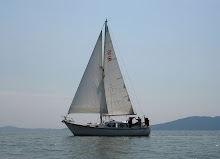
The weather's been fine and we've entertained ourselves. Mo climbed the mast for this shot looking down at the boat. Note the fixture on the sunny dock.
Craig is a quaint little fishing town with a logging problem. Big Forest Service presence here. Mo noticed all the Craig municipal vehicles are old green rigs from the FS. The town is rustic, built around the old cannery, and some false fronts are still standing.
The old cannery is an interesting stroll. Good boardwalk. Notice Chance looking for a spot to sprawl.

~~~~~~~~~~~~~~

We spent two days on Baker Island in Port San Antonio and enjoyed walks through the old-growth forests, a posse of otters, mink, and black-tail deer. The coconut rockfish stew was also good.
What wasn't good was all the beach litter. Open to the Pacific Gyre, most of the beaches on the outer coast are inundated with fishing nets, floats, and other fishing junk. Somebody needs to pass a law against using anything plastic on fishing boats. We'd guess that 95% of it was fishing-related. We even found a battered porta-toilet. The computer cables were an interesting find, though. CRT cables, power cables, any kind of cables could be found on the beaches. Probably a container ship that sank or something tragic. Like the famous Nike container that washed overboard years ago and sent new (but soggy) sneakers to residents of the coast for years.
But man, we gotta clean up our act. This is getting ridiculous. Beaches are not dumps.

Monday, June 07, 2010

Alaska at last!


Well, we could have rowed the dinghy with one oar here faster, but we finally made the last frontier.

Crossing the border was quickly celebrated by a 2008 Alaskan Smoked Porter bought in Washington. A very tastey way to come into the country.

We anchored for a night in crowded Foggy Bay, the first protected spot from the Canadian border to Ketchikan, and where everybody stops, it seams. The bay filled up in the evening, and emptied at 06:30. We had a glorious 30 mile sail on a run all the way through the narrows and nearly up to the dock. We gybed once - the wind was so steady. It is amazing how good that feels.

As we sailed past, Mo pointed out the elementary she and Petra Wilm worked on back in the Cretaceous Period.


We settled into Bar Harbor and set out for a walk to town along the busiest road in Alaska, they tell us. Apparently not a commuting town. This totem pole, we thought pretty well sums up the sentiments of most Ketchikan residents towards the cruise ship tourists.

After seeing this one, and a few others with similar themes....
We started to take our own protection around the totem poles in town a little more seriously. Mo had to fight off this monsterous and agressively postured beaver. I was too busy laughing.

We somehow survived the totem park, and straggled into the old red light district, Creek Street. Where both salmon and men used to go upstream to spawn...

As Johnathan Raban wrote in his thoughtful book Passage to Juneau, a sea and its meaning, a fellow could probably still find a good time in today's Ketchikan just a few blocks further on. But they don't sell postcards of that neighborhood. A diversion from the Creek Street diversions was needed, and a new trail built to allow safe passage for the good men of Ketchikan. Heck, even the fish get an easier way.


We met a kinsman Matthew again. He's sailed his 20' Flicka (a boat model that has circumnavigated, by the way) Alacrity from Seattle, and carries a packraft for a dinghy. We got off on the right foot from the start and had a beer with him in Prince Rupert, then pulled in two slips away in Ketchikan. He was meeting his friend Kelly to go around Misty Fjords and points north. We know we'll cross paths again, and wish them fair winds.
Then the world stopped for a bit as we spotted our first pipefish. Really a straightened seahorse, they are somewhat legendary and really hard to spot. They look just like a piece of floating eelgrass. The tiny fin on her back undulates, so she doesn't need to move and attract attention. Like the seahorses, the males also brood the young in their belly pouch. So great.
Did we mention it's good to be back in Alaska?